In the precision-driven universe of industrial machining, the choice between M35 and M42 cobalt high-speed steel (HSS) straight shank twist drills is more than a technical decision—it’s a strategic investment in productivity. As the backbone of hole-making operations across industries, these drills combine robust engineering with advanced metallurgy to tackle materials from soft plastics to superalloys. This article dissects the nuances between M35 and M42 cobalt drills, empowering manufacturers to optimize their tooling strategy.
The Anatomy of Excellence: HSS Straight Shank Twist Drills
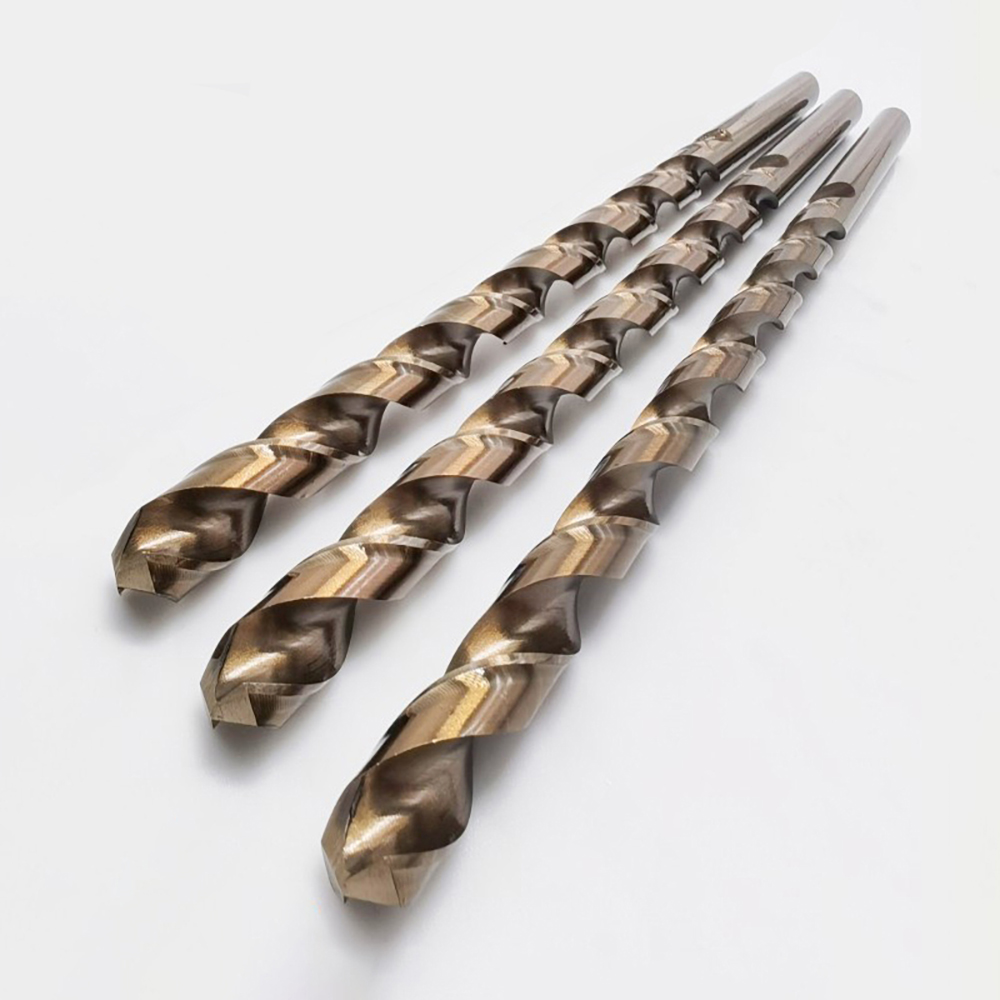
The straight shank twist drill’s universal appeal lies in its simplicity and adaptability. Featuring a cylindrical shank (h6 tolerance) for secure clamping in CNC collets, drill chucks, and milling machines, these tools dominate diameters from 0.25mm micro-drills to 80mm heavy-duty boring bits. The dual-spiral groove design, with helix angles ranging from 25° to 35°, ensures efficient chip evacuation, while 118°–135° point angles balance penetration force and edge stability.
Cobalt’s Crucible: M35 vs M42 Metallurgical Showdown
The battle between M35 (HSSE) and M42 (HSS-Co8) cobalt drills hinges on their chemical composition and thermal resilience:
M35 (5% Cobalt): A balanced alloy offering 8–10% toughness advantage over M42, ideal for interrupted cuts and vibration-prone setups. Heat-treated to HRC 64–66, it withstands temperatures up to 600°C.
M42 (8% Cobalt): The pinnacle of red hardness, retaining HRC 65+ at 650°C. With added vanadium for wear resistance, it excels in continuous high-speed drilling but demands careful handling to prevent brittleness.
Third-party abrasion tests reveal M42’s 30% longer tool life in 304 stainless steel at 30 m/min, while M35 outperforms by 15% in impact resistance during peck drilling cycles.
Performance Matrix: Where Each Alloy Reigns Supreme
M35 Cobalt Drills: The Versatile Workhorse
Optimal For:
Intermittent drilling in cast iron and low-carbon steels
Composite materials (CFRP, GFRP) requiring vibration damping
Job shops with mixed-material workflows
Economy Edge: 20% lower cost-per-hole vs M42 in non-abrasive applications
M42 Cobalt Drills: The High-Temperature Champion
Dominates In:
Aerospace titanium (Ti-6Al-4V) and Inconel drilling at 40+ m/min
Deep-hole drilling (8xD+) with through-tool coolant
High-volume production of hardened steels (HRC 45–50)
Speed Advantage: 25% faster feed rates in stainless steel vs M35
Industry-Specific Triumphs
Automotive: M35 drills engine blocks (aluminum A380) with 50,000-hole lifespan; M42 conquers brake rotor cast iron at 1,200 RPM dry.
Aerospace: M42’s TiAlN-coated variants slash drilling time in nickel alloys by 40% vs carbide tools.
Electronics: M35’s 0.3mm micro-drills pierce copper-clad laminates without burring.
Operational Intelligence: Maximizing Drill Potential
Coolant Strategy:
M42: High-pressure emulsion (70 bar) mandatory for >10mm diameters
M35: Mist coolant suffices for most applications under 8xD depth
Speed Guidelines:
Aluminum: M35 @ 80–120 m/min; M42 @ 100–150 m/min
Stainless Steel: M35 @ 15–20 m/min; M42 @ 20–30 m/min
Peck Cycling:
M35: 0.5xD peck depth for gummy materials
M42: Full retract every 3xD to prevent edge microfractures
Cost-Benefit Breakdown
While M42’s upfront cost is 25–30% higher than M35, its ROI shines in:
High-Temp Operations: 50% longer regrinding intervals
Batch Production: 18% lower tooling cost per 1,000 holes in 17-4PH stainless
For SMEs with variable workloads, a 70:30 M35/M42 inventory ratio balances flexibility and performance.
The Future Edge: Smart Drilling Ecosystems
Next-gen M42 drills now feature IoT-enabled wear sensors, transmitting real-time edge degradation data to CNC systems for predictive tool changes. Meanwhile, M35 variants are embracing graphene-enhanced coatings, boosting lubricity by 35% in dry machining.
Conclusion
The m35 vs m42 cobalt drills debate isn’t about superiority—it’s about precision alignment with operational needs. M35 cobalt drills offer democratic adaptability for diverse workshops, while M42 emerges as the aristocrat of high-velocity, high-heat machining. As Industry 4.0 reshapes manufacturing, understanding this dichotomy isn’t just technical prowess—it’s the key to unlocking sustainable competitive advantage. Whether drilling micrometer-scale PCB vias or meter-long turbine shafts, choosing wisely between these cobalt titans ensures every revolution counts.
Post time: May-13-2025


