In precision machining, the stability and efficiency of workpiece clamping directly determine machining quality and production cycle time. Traditional manual vises rely on threaded joints for force amplification, which is laborious to operate and difficult to guarantee consistent clamping force. While external hydraulic vises offer strong clamping force, their complex piping layout and large space requirements make them unsuitable for the compact needs of automated production lines. In recent years, the built-in hydraulic vise, as an innovative product integrating hydraulic force amplification and a compact structure, has become a key supporting equipment for CNC machine tools and flexible manufacturing units due to its advantages such as high rigidity, rapid response, and no piping required.
The core technological breakthrough of the built-in hydraulic vise lies in the complete integration of the hydraulic force amplification mechanism within the vise body. Unlike traditional hydraulic vises with external cylinders, this product uses a built-in micro hydraulic cylinder and a booster mechanism to convert the initial manual or pneumatic input force into several times or even tens of times the clamping force. The entire process requires no external oil pipe connection, completely eliminating the risks of pipeline leakage and spatial interference.
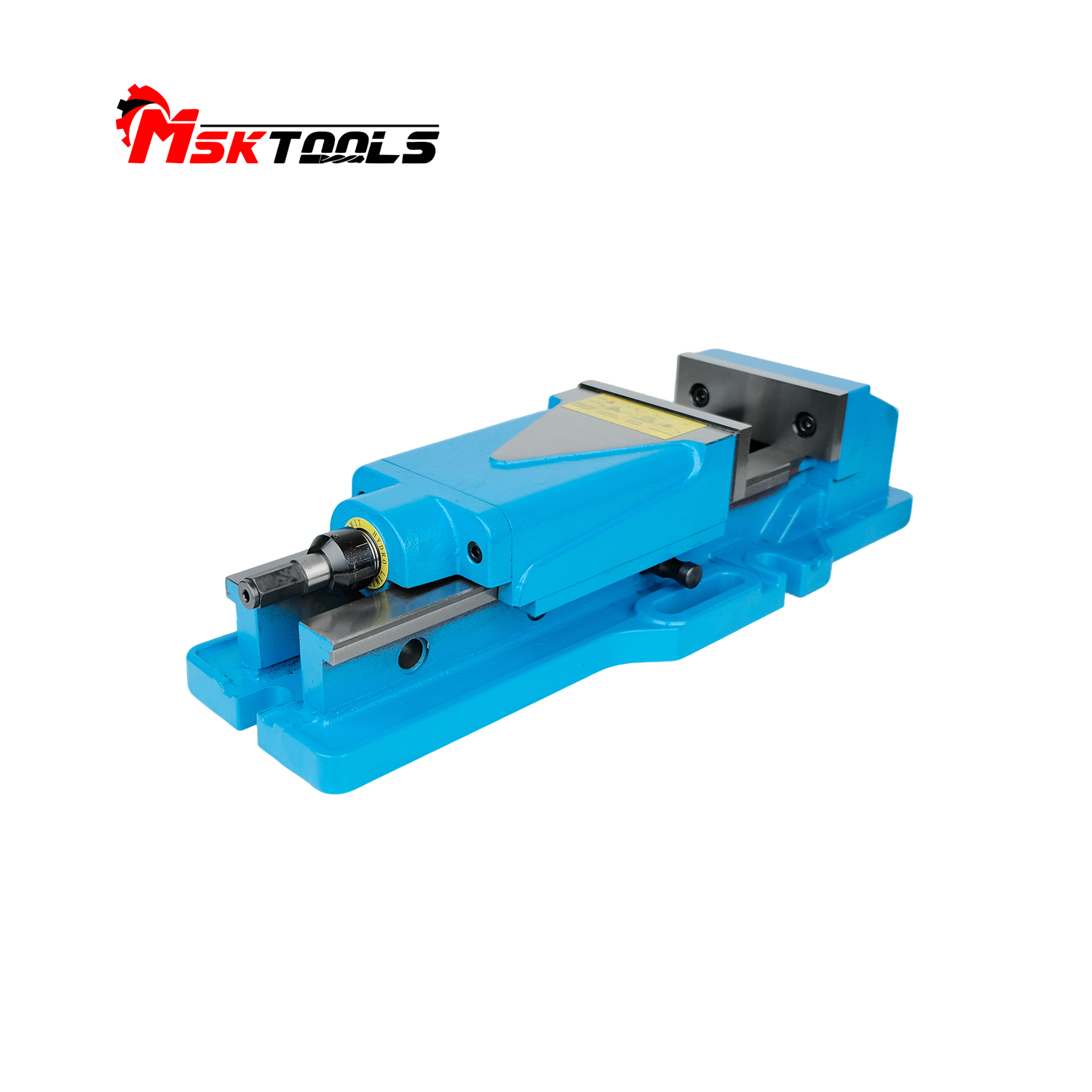
Taking the latest industry-developed model as an example, it adopts an integrated sealed oil circuit design and a self-locking hydraulic valve group. The operator only needs to use a standard wrench or input a small torque via pneumatic drive, and the built-in mechanism automatically completes the pressure tightening. The clamping force can reach over 30kN and remains constant throughout the entire stroke range, with a repeatability accuracy within 0.01mm, effectively solving the problem of clamping force attenuation caused by wear in traditional thread vises.
Looking to the future, technological innovation in built-in hydraulic vises will advance along two lines: intelligent integration and modular design. At the intelligent level, the introduction of technologies such as built-in sensors, RFID identification, and data interfaces enables the vise to communicate with the machine tool's CNC system in real time, providing feedback on key parameters such as clamping force, temperature, and vibration, offering data support for predictive maintenance and process optimization. At the modular level, the quick-change jaw system and multi-station base design allow the same vise to quickly adapt to workpieces of different shapes and sizes, significantly improving equipment utilization and production line flexibility.
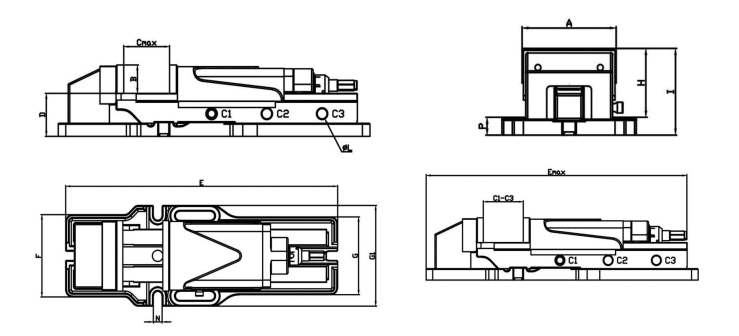
From manual force enhancement to built-in hydraulics, from stand-alone operation to system integration, the technological evolution of concealed hydraulic vises reflects a clear trajectory of precision machining moving towards high efficiency and intelligence. With continuous breakthroughs by domestic companies in hydraulic control, precision manufacturing, and intelligent sensing, domestically produced high-end concealed hydraulic vises are expected to gain greater influence in the global market, contributing efficient clamping solutions to global precision manufacturing.
Post time: Mar-27-2026


